Role
UX Designer
Duration
Jan 2025 - Feb2025
Team
1 UX designer, 2 PMs,
1 UX researcher,
1 technical writer, 2 tech teams
1 UX researcher,
1 technical writer, 2 tech teams
Tools
Figma
Overview
In 2024, Amazon Customer Service handled 68mm repeat contacts (23% of total), with 10.5% involving 3+ contacts—a segment growing 20bps YoY. 1 in 4 follow-ups were missed, revealing a gap between customer needs and Amazon’s support.
Case management is a system in Amazon customer care center designed to help CSAs (customer service associates) track, organize, and resolve customer issues by consolidating all interactions into a single, unified case.
Before case management, Amazon lacked an effective system to track and resolve multi-contact issues, leading to customer frustration and inefficiency.
Case management is a system in Amazon customer care center designed to help CSAs (customer service associates) track, organize, and resolve customer issues by consolidating all interactions into a single, unified case.
Before case management, Amazon lacked an effective system to track and resolve multi-contact issues, leading to customer frustration and inefficiency.
DEFINING THE PROBLEM
Current state: Multiple contacts for delayed delivery
Extended time & effort on each contact
Customers are experiencing extended contact times due to repeating their issue throughout the contact and manual processes on the part of CSAs.
Inaccurate and inconsistent information from CSAs
Customers may receive inaccurate and inconsistent information from CSAs, leading to frustration and a lack of trust in Amazon customer service.
No visibility into SSA bot interactions
CSAs can’t see prior bot conversations, forcing customers to repeat their issues. This fragmented view delays resolutions and CSAs lack full context to act confidently.
Hard to identify the issue root causes
Critical details (e.g., delivery delays, refund triggers) are scattered across systems. CSAs need to go to different sources to find the root causes
Policy gaps hidden in AC3 workflows
Key policies (e.g., returns post-refund) aren’t surfaced during CSA workflows. This leads to miscommunication, surprise follow-ups for customers, and avoidable repeat contacts that erode trust.
Vision
Our vision is to ensure CSAs can resolve customer issues with speed, clarity, and empathy by transforming case management into a unified, proactive, and adaptive system.
CHALLENGES & ITERATIONS
Design challenge 1: Fragmented Context
How might we consolidate interactions among customer, SSA, and CSAs into a single view?
Activity tab - first iteration
Description: consolidate All interactions among customer, bot in SSA, and CSA in AC3 into the same tab.
Rationale: CSAs can have a clear view of all activities without visiting different resources.
Issue:Chronological activity feeds without thematic grouping force CSAs to manually hunt for related interactions (e.g., refund requests across chat, email, calls). This wastes time, misses patterns, and still does not resolves fragmented context problem in the system.
Description: consolidate All interactions among customer, bot in SSA, and CSA in AC3 into the same tab.
Rationale: CSAs can have a clear view of all activities without visiting different resources.
Issue:Chronological activity feeds without thematic grouping force CSAs to manually hunt for related interactions (e.g., refund requests across chat, email, calls). This wastes time, misses patterns, and still does not resolves fragmented context problem in the system.
Activity tab - second iteration
Description: Group relevant activities into different issue thematic groups
Rationale: Thematic grouping organizes interactions by issue type (e.g., refunds, deliveries), reducing cognitive load and time spent hunting for context. By consolidating related activities, CSAs quickly spot patterns, identify root causes, and resolve issues faster.
Description: Group relevant activities into different issue thematic groups
Rationale: Thematic grouping organizes interactions by issue type (e.g., refunds, deliveries), reducing cognitive load and time spent hunting for context. By consolidating related activities, CSAs quickly spot patterns, identify root causes, and resolve issues faster.
Task tab:
Lists specific actions CSAs need to take (e.g., review ticket, follow up with customer)
Rationale: A task tab organizes follow-ups and tickets in one place. It ensures CSAs don’t miss steps, prioritizes critical actions (like canceling returns), and tracks progress. This clarity prevents errors, reduces repeat contacts, and ties tasks to root causes for systemic fixes.
Lists specific actions CSAs need to take (e.g., review ticket, follow up with customer)
Rationale: A task tab organizes follow-ups and tickets in one place. It ensures CSAs don’t miss steps, prioritizes critical actions (like canceling returns), and tracks progress. This clarity prevents errors, reduces repeat contacts, and ties tasks to root causes for systemic fixes.
Attachments tab:
All case-related files are stored in one place.
Rationale:Allows CSAs to verify customer claims (e.g., delayed delivery) with uploaded proof, ensuring accurate resolutions.
Eliminating the need to search through emails or other systems.
All case-related files are stored in one place.
Rationale:Allows CSAs to verify customer claims (e.g., delayed delivery) with uploaded proof, ensuring accurate resolutions.
Eliminating the need to search through emails or other systems.
Research
Interview with CSAs
Design Challenge 2: Hidden Root Causes
How might we detect workflow-policy mismatches and inform CSAs?
Description:
AI/ML Detection
1.Train models to compare workflows against policy documents.
2.Flag mismatches (e.g., missing return warnings in refund workflows).
Integration with Case Data
Link mismatch to the root causes of the case issue.
Rationale:
1.AI flags mismatches faster than manual audits.
2.Every resolved case improves the system (e.g., updated workflows → fewer repeats → better data → sharper detection)
3.Customers get accurate info upfront, reducing frustration and follow-ups.
Turn reactive fixes into proactive prevention, creating a cycle where every case makes the system smarter and customers happier.
AI/ML Detection
1.Train models to compare workflows against policy documents.
2.Flag mismatches (e.g., missing return warnings in refund workflows).
Integration with Case Data
Link mismatch to the root causes of the case issue.
Rationale:
1.AI flags mismatches faster than manual audits.
2.Every resolved case improves the system (e.g., updated workflows → fewer repeats → better data → sharper detection)
3.Customers get accurate info upfront, reducing frustration and follow-ups.
Turn reactive fixes into proactive prevention, creating a cycle where every case makes the system smarter and customers happier.
Next steps
Collaborate with other AI related projects
CSA Override Options: Allow CSAs to bypass or edit AI recommendations.
Human-in-the-Loop Design: Combine AI suggestions with CSA expertise for complex cases
Human-in-the-Loop Design: Combine AI suggestions with CSA expertise for complex cases
Enhance AI Accuracy
Improve Training Data: Use diverse, real-world case data to reduce bias.
Continuous Validation: Regularly test AI outputs against CSA decisions to refine models.
Continuous Validation: Regularly test AI outputs against CSA decisions to refine models.
Monitor and Iterate
Real-Time Dashboards: Track metrics like repeat contacts, resolution time, and CSA feedback.
Feedback Loops: Use CSA and customer input to prioritize updates.
Feedback Loops: Use CSA and customer input to prioritize updates.
Other case studies
There are 6 Consumer CSAs, 4 CSAs from digital devices, 3 shipping & delivery support CSAs, 4 Amazon Business CSAs, and 6 in Other Verticals/Groups, with frontline and back-office roles distributed accordingly. CSAs are primarily located in India (9) and the US (6), with smaller numbers in Ireland, UK, Netherlands, Italy, Costa Rica, Brazil, and Germany. 12 CSAs have encountered repeat contact and 9 CSAs have used routed work Item flow.
Here are some key findings:
Here are some key findings:
Logical Flow and Design
CSAs expect a logical and intuitive layout of case information and issue summaries that aligns with their workflow. Ensuring that critical information is easy to locate and understand can help reduce repeat contacts and improve efficiency.
Communication Preferences
Associates prefer personalized communication over automated emails, especially for sensitive issues or when confirming resolutions. They suggest having the option to tweak or personalize generated emails to better suit the customer's situation.
Access to Detailed Information
CSAs appreciate the ability to access additional details through hyperlinks and direct routing, which saves time and reduces the need for manual data entry. This helps in validating information and providing accurate resolutions.
Trust in Summarizations
While CSAs value consolidated information and summaries, they still feel the need to validate this information. Building trust in AI-generated summaries will require high accuracy and reliability.
By incorporating the key findings from case management early concept evaluation, we defined the vision for case management.
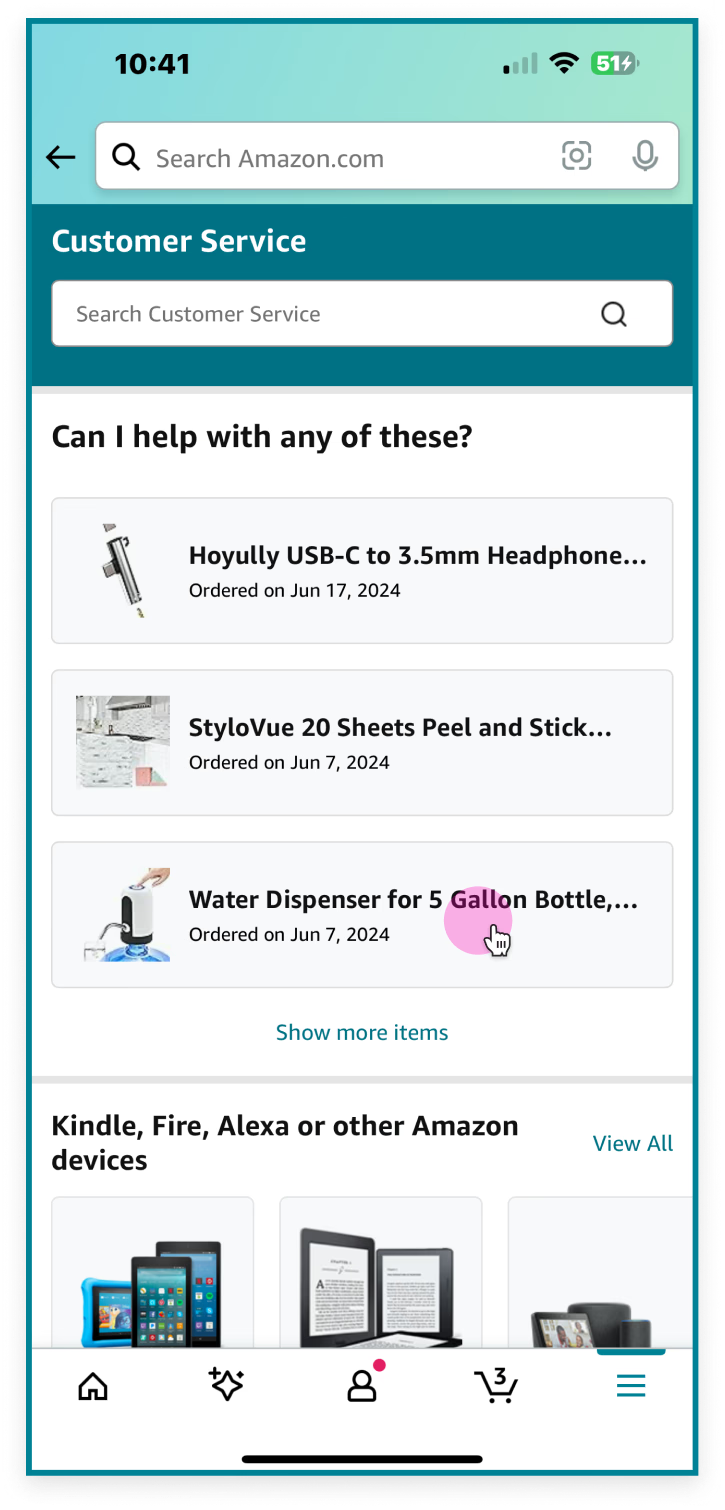
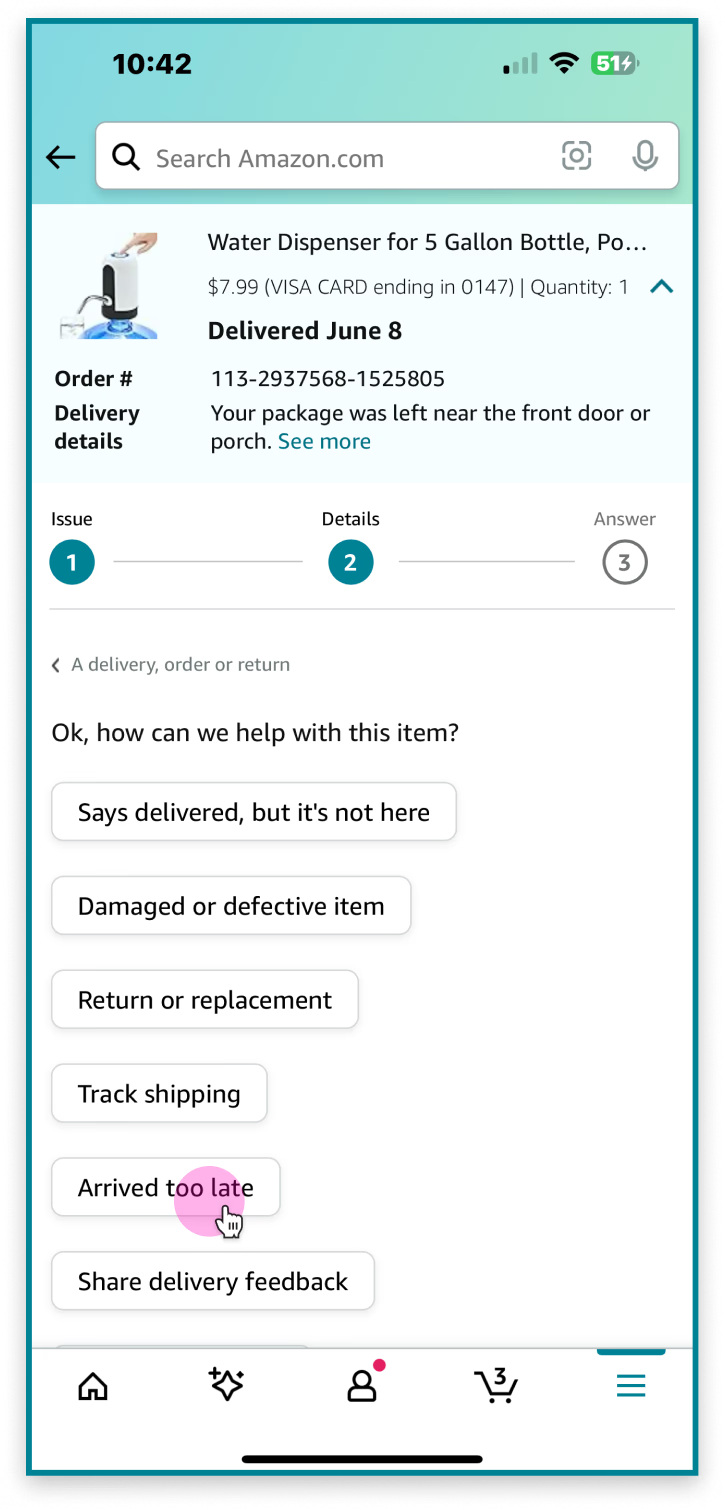
Customer in self service.
 First contact
Sean asked Amazon’s self-service bot for a refund due to a delayed delivery. The bot said he had to wait for the new delivery date.
Second contact
CSA in AC3 issued a resolution to customer in the call with customer.
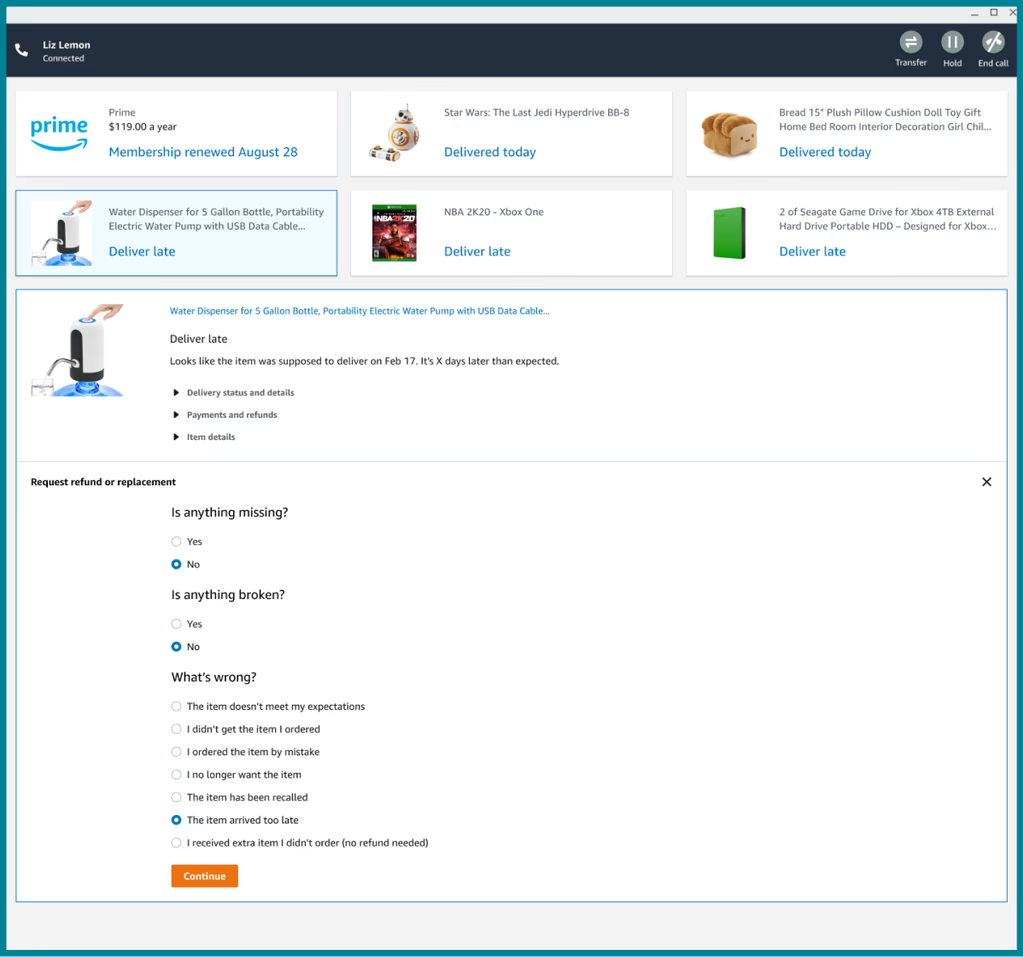
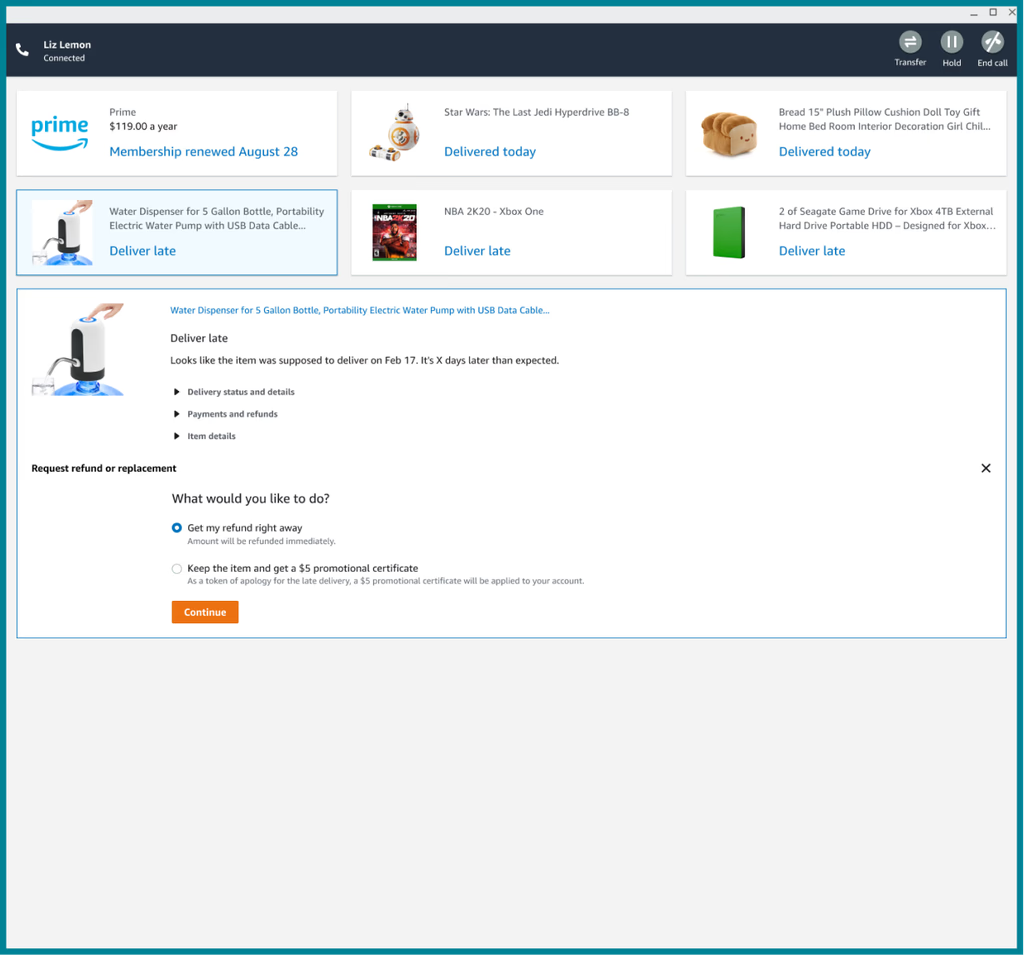
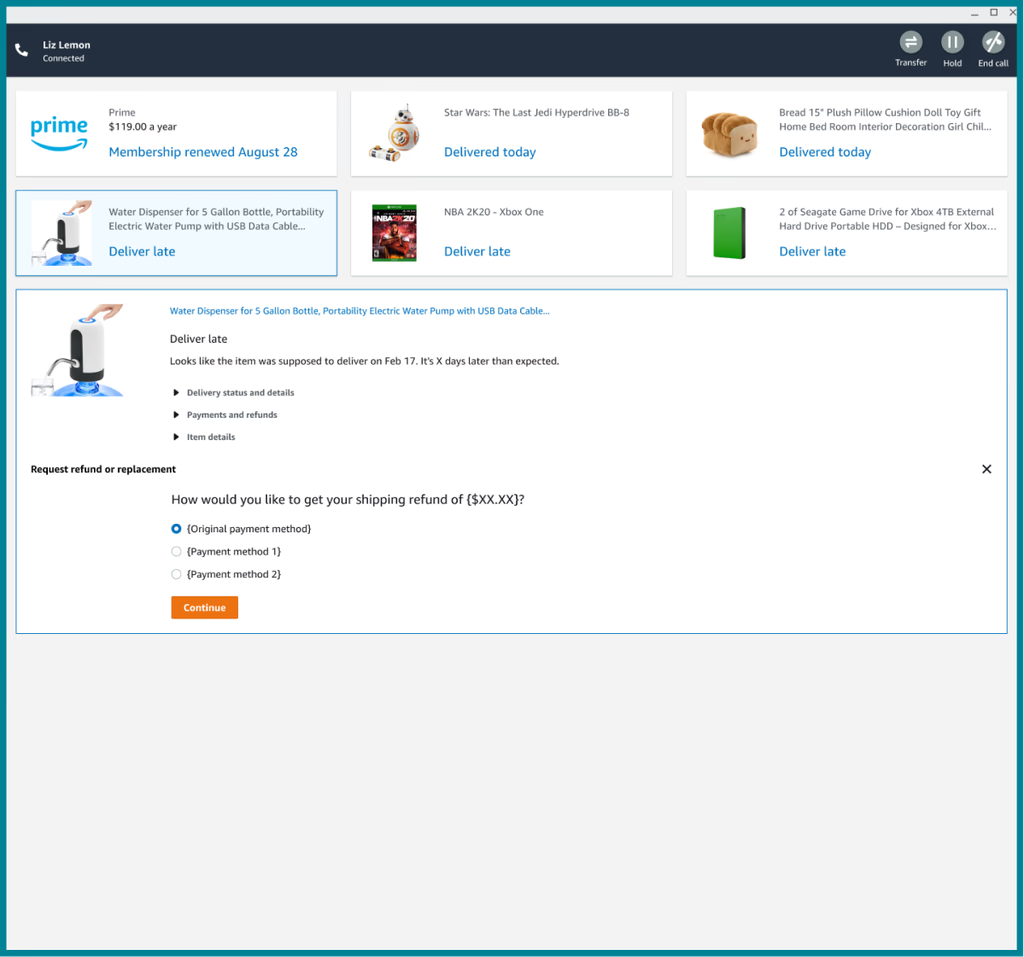
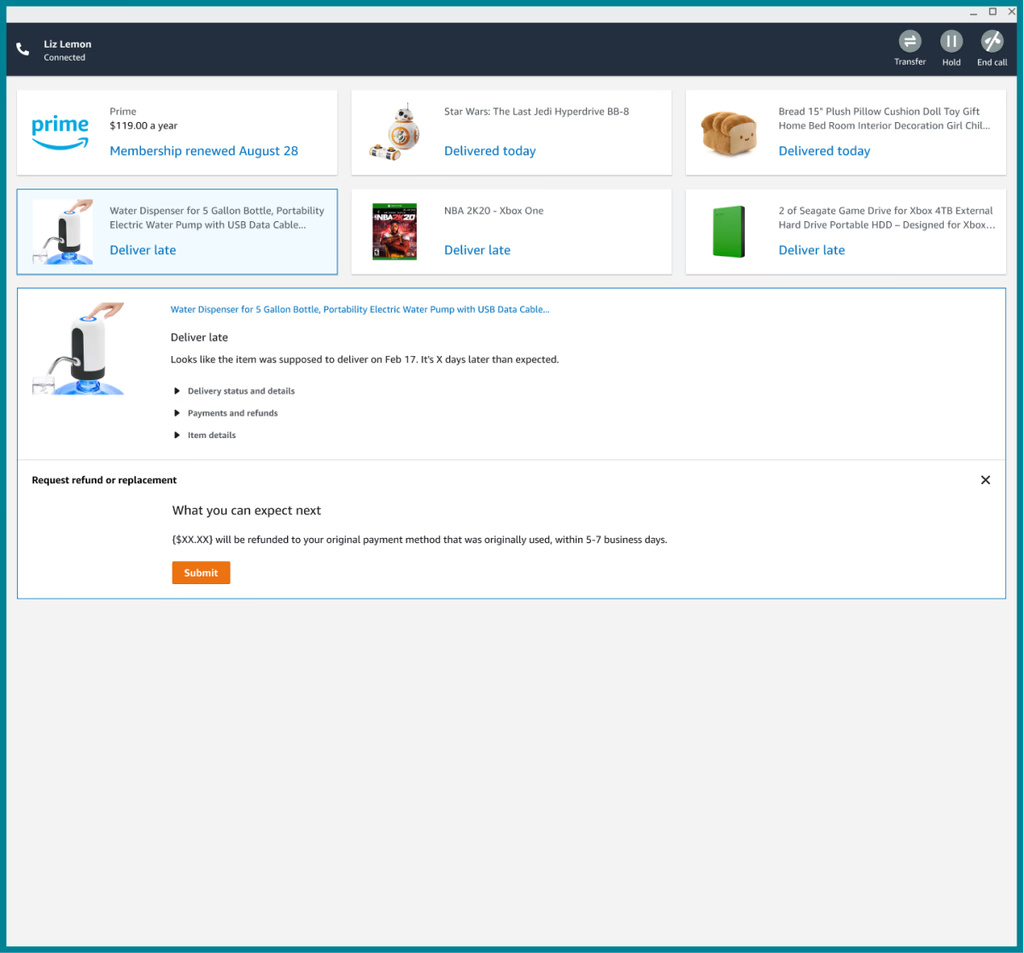
Customer called in again since the item was still not delivered after the new delivery date. CSA entered AC3 system and navigated through the workflow to issue customer a refund.
CSA submitted the refund in AC3.
Third contact
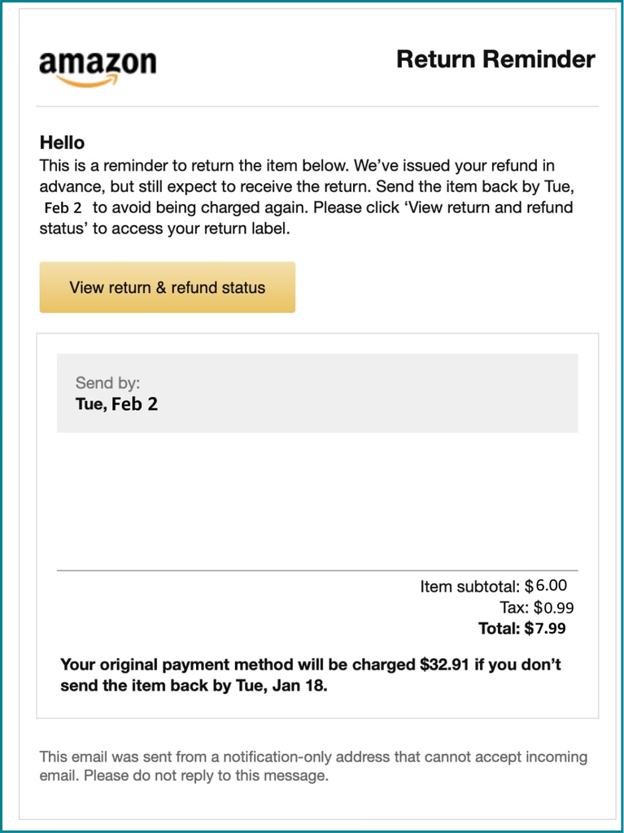
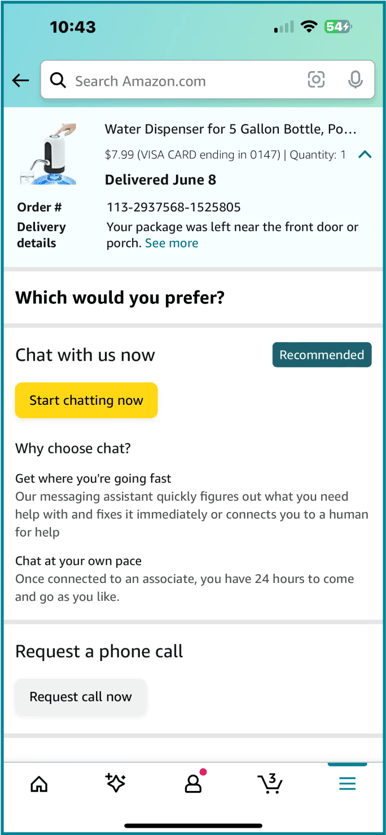 Customer received an email about the return and called back.
Customer received the email to return the item, which was not informed by the CSA in the previous contact. Customer decided to request a call to talk to a CSA in customer service to cancel the return.
Fourth contact
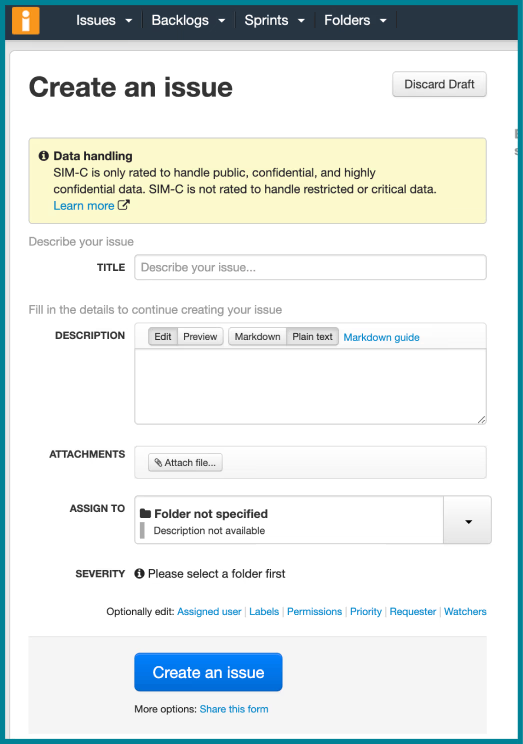
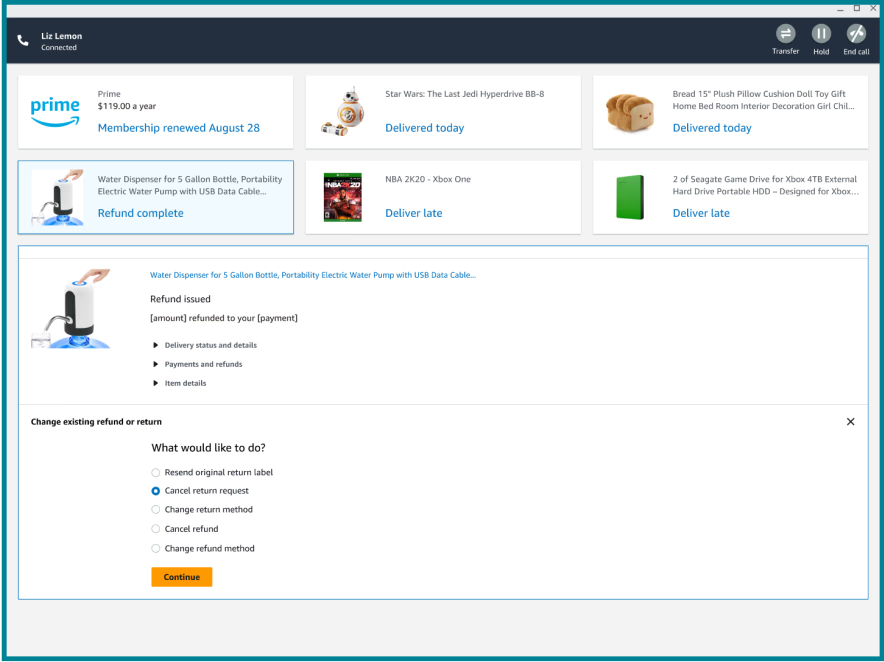
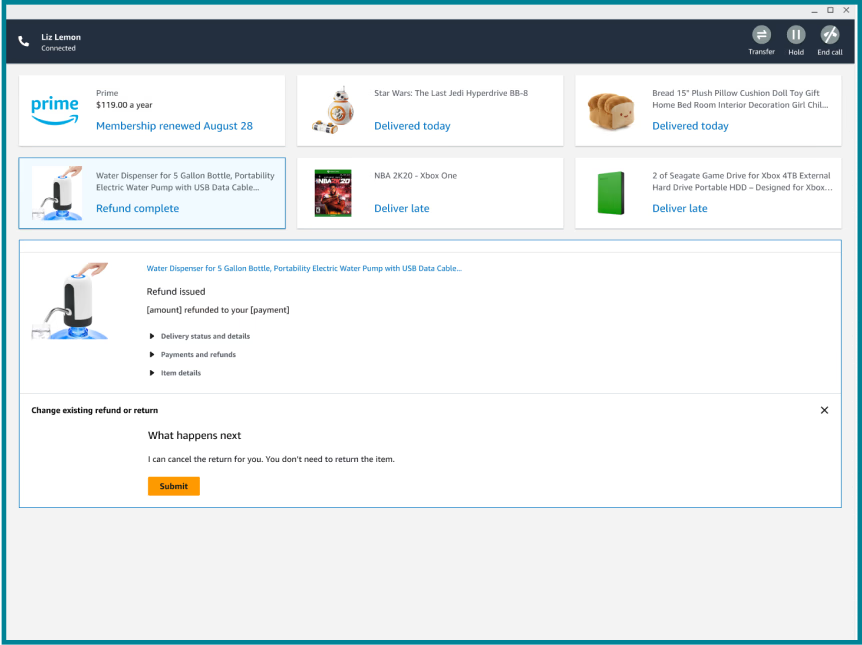
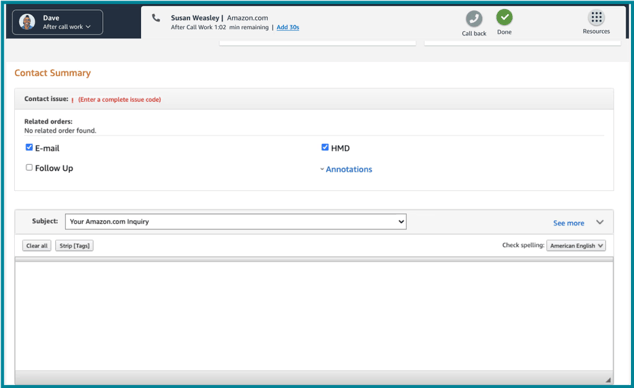 CSA submitted an issue about the workflow and followed up with customer after the return was canceled.
CSA entered the internal ticketing workflow to submit an issue about the workflow - The workflow does not reflect the latest return policy.
After the workflow got updated, CSA selected the item and canceled the return for customer.
CSA followed up with customer about the cancel return of the original item via email.
How might we surface root causes without overwhelming CSAs?
Description: when a CSA enters the new workflow, the system generates a response for CSAs.
Rationale: the AI can summarize the issue customer shares with CSAs from different channels, and generate necessary questions that can resolve customer's problems.
Rationale: the AI can summarize the issue customer shares with CSAs from different channels, and generate necessary questions that can resolve customer's problems.
FINAL DESIGN
Final design
Description:
Case Header
Displays the case ID and case status
Pending Tasks
1.Lists actionable items (e.g., confirm return policy, submit ticket, cancel return).
2.Ensures CSAs know what needs to be done.
Summary
1.Breaks down issues and their root causes.
2.Provides context for CSAs to understand the problem holistically.
Order IDs & Repeat Contacts
1.CSA can copy order ID and use other tools in AC3 to look for order information.
2.Helps CSAs prioritize cases with recurring issues.
Assigned To
Clearly states who is responsible for resolving the case
Rationale:
Action-Oriented
1.The Pending Tasks section ensures CSAs know what to do next, reducing errors and oversights.
2.Case Summary provides a high-level overview of issues and causes, helping CSAs understand the full picture
Case Header
Displays the case ID and case status
Pending Tasks
1.Lists actionable items (e.g., confirm return policy, submit ticket, cancel return).
2.Ensures CSAs know what needs to be done.
Summary
1.Breaks down issues and their root causes.
2.Provides context for CSAs to understand the problem holistically.
Order IDs & Repeat Contacts
1.CSA can copy order ID and use other tools in AC3 to look for order information.
2.Helps CSAs prioritize cases with recurring issues.
Assigned To
Clearly states who is responsible for resolving the case
Rationale:
Action-Oriented
1.The Pending Tasks section ensures CSAs know what to do next, reducing errors and oversights.
2.Case Summary provides a high-level overview of issues and causes, helping CSAs understand the full picture
RISKS AND NEXT STEPS
Risks
AI Inaccuracy
If the AI misflags policy gaps or misses root causes, it could frustrate CSAs or leave issues unresolved. We’re mitigating this by continuously refining the AI with real-world data and allowing CSAs to override its suggestions.
Over-Reliance on Automation
If CSAs rely too much on AI, they might lose critical thinking skills or make interactions feel impersonal.
Technical Challenges
As case volumes grow, the system must scale without slowing down. We’re stress-testing the platform and building modular architecture to handle future demands.
Before:
CSAs need to navigate through different systems to investigate the root causes of the issue.
After:
CSA can see all interactions in a single, unified case.
CSAs need to navigate through different systems to investigate the root causes of the issue.
After:
CSA can see all interactions in a single, unified case.